Gas Safety: Easy to Forget 1 Day a Year. But at What Cost?
England · 5 min read · 27 August 2026

A healthy gas flame burns blue. A lazy yellow-orange flame is one of the warning signs your engineer, and your tenant, should never ignore.
The gas safety record is in a drawer somewhere. It was definitely done last year, and the renewal date is roughly... around now? If that small hum of doubt sounds familiar, you're not alone. The annual gas safety check is one visit a year, carried out by a registered engineer, and a paper trail that protects everyone under the roof, tenant and landlord alike. Getting it right comes down to three things: booking the check, keeping the records in order, and understanding how the renewal dates work. Here's how to do all three, and optimise your gas safety.
Understanding the Gas Safety Check
Since 1998, the Gas Safety (Installation and Use) Regulations have placed a clear duty on you as a landlord. Every gas appliance you provide (boiler, hob, fire, water heater) and every flue must be checked for safety at least every 12 months, and a record of that check given to the tenant. You'll often hear the record called a CP12, or the Landlord Gas Safety Record.
The check must be carried out by an engineer on the Gas Safe Register, the official register of engineers legally allowed to work on gas in the United Kingdom (it replaced CORGI in 2009). Anyone working on gas who isn't registered is breaking the law, and their paperwork won't protect you, so check they're on the register before you book.
The Importance of the Annual Check
The annual check matters for several reasons:
- It protects lives. Faulty gas appliances cause fires, explosions and carbon monoxide poisoning, a risk you cannot see or smell.
- It is a criminal offence to miss it. The Health and Safety Executive enforces the regulations, with unlimited fines and even imprisonment in serious cases.
- It protects your possession rights. Courts have refused possession claims where landlords couldn't show the gas safety record was properly served. Compliance underpins your professionalism as well as the tenant's safety.
- It protects your insurance. Many landlord policies can be void if a gas safety check is overdue.
Steps to Getting It Right
Booking the Right Engineer
Find an engineer through the official Gas Safe Register. Even with someone you've used for years, it's worth checking the register before booking, every time. Registrations lapse, and there's no harm confirming theirs is current. You won't usually be there on the day, so the doorstep check belongs to the tenant. The engineer carries a Gas Safe ID card, front and back, and the back lists exactly which gas work they're qualified to do. A good engineer expects it to be looked at.
A practical tip from experience: around three weeks before the check is due is the sweet spot. That's enough time to arrange access with the tenant, but not so early the diary is already full. Factor in summer and bank holidays, and leave enough room to check in with both the engineer and the tenant on availability.
The Renewal Window: Keep Your Date
Here is the rule that saves you money every year. Since 2018, the law works like a car's MOT. If the renewal check is done in the final two months before the due date, the new record runs from the old expiry date. You keep your anniversary, and you lose nothing by booking early within that window. In real dates: a record due 8 February can be renewed any time from 8 December, and the new record still runs to next 8 February.
Renew earlier than that window, though, and the 12-month clock restarts from the new check date. The renewal date creeps forward, and over the years you pay for more checks than you needed.
Your records are what show when each check was done, so keep every one, in order, somewhere easy to find. The law requires you to keep each record until two further checks have been carried out: this year's, last year's and the one before.
Serving the Record on Your Tenant
This is a time-sensitive and crucial step. A copy of the record must be given to existing tenants within 28 days of the check, and new tenants must receive the current record before they move in. Keep a note of the date it was served. If you ever need to prove compliance, the serving date matters as much as the check itself. A habit worth copying: photograph the record on move-in day alongside the keys and the check-in inventory. One photo, three pieces of evidence.
In practice there's more than one way to get this done. Sometimes the engineer leaves a copy with the tenant on the day and sends you the landlord's copy. Or you can ask the tenant to photograph their copy and send it back, which neatly demonstrates they've been served theirs.
Reading What the Engineer Writes
The engineer may record defects or advisory notes. Sometimes these are coded (ID for Immediately Dangerous, AR for At Risk, NCS for Not to Current Standards), sometimes they're plain handwriting in the defects box. Don't gloss over them. The engineer is the qualified voice. Your job is to read what they wrote, ask questions at the visit, and deal with anything that needs action. Understand the advisories, if any, so they can be picked up by the next person visiting. An advisory left unread this year has a habit of becoming a bigger conversation next year.
During the Year
- Carbon monoxide alarms: since October 2022, any room with a fixed gas appliance such as a boiler, gas fire or gas water heater must have a carbon monoxide alarm (Smoke and Carbon Monoxide Alarm (Amendment) Regulations 2022). If a tenant reports any alarm faulty, you must repair or replace it promptly, and record and retain evidence that you did.
- Tenant reports: treat any report of a gas smell, pilot lights going out, or sooty marks around appliances as urgent. The Gas Emergency line (0800 111 999) is free and 24-hour.
- Keep your file in order: the current record, last year's, and the one before. The law requires you to keep each record for at least two years, and the renewal-window rule rewards you for keeping them all.
If the Check Finds a Problem
Don't panic. This is the system working. The engineer will make anything dangerous safe (which can mean disconnecting an appliance), tell you and the tenant what they've found, and set out what needs fixing. Arrange the remedial work, have the engineer return to re-check, and the record is back on track. A failed check followed by a prompt fix is a landlord doing their job. An unread record is not.
If an appliance has to come out of service, it helps to know where you stand. The law (Landlord and Tenant Act 1985, s.11) requires you to repair gas installations and heating within a reasonable time. It doesn't oblige you to provide a replacement appliance in the meantime. But here's the practical wisdom: a stop-gap you offer (a plug-in hob while the cooker connection is fixed, electric heaters while the boiler waits for a part) keeps the tenant cooking and warm, counts in your favour on what's "reasonable", and protects against a disrepair claim. It isn't a legal duty. It's just what a decent landlord does, and the law quietly rewards it.
Arranging Access with Your Tenant
Tenants must allow reasonable access for safety checks, but goodwill gets the appointment booked faster than the tenancy agreement does:
- Communicate early: give the tenant the date options as soon as possible.
- Explain why: "this is your annual safety check" lands better than "the engineer is coming".
- Be flexible: ask the engineer to commit to a morning or afternoon window, so the tenant isn't waiting in all day.
- Be the conduit: take the dates the engineer can do, then give your tenant those options to choose from. That exchange is a record in itself — proof you arranged the visit and gave your tenant the choice of when it worked for them.
- Document attempts: if appointments are not kept, keep a written record of every attempt. HSE says its inspectors look for repeated attempts, and advises leaving a note after a missed visit and writing to your tenant to explain the check is a legal requirement for their safety. No law requires the engineer to record a failed visit, so the records that matter here are your own. Asking the engineer to photograph the card they post through the door is good practice that strengthens the file. It's the evidence that all reasonable steps were taken.
The Renters' Rights Act: Your Records Go on the Database
The Renters' Rights Act 2025 adds a new reason to keep this paperwork in order. From late 2026, every private landlord will have to register themselves and each property on a new Private Rented Sector Database, and the government's roadmap lists the safety information that registration captures: gas, electrical and energy performance certificates. Signing up is mandatory, with an annual fee.
This is a real shift. Under the old rules, the pressure to serve a gas safety record on time came mostly from possession law, and that route has changed: the Act abolished Section 21, so the old "serve the certificate or you can't evict" mechanism no longer applies. In its place, a landlord who hasn't met the registration duty can't get a possession order, and councils can issue civil penalties for letting without registering.
The upshot is the same habit this whole guide is about: keep every gas safety record, in date order, somewhere you can produce it on demand. When the database asks for the safety certificates, the landlord who has them filed and ready is done in minutes.
Your Annual Gas Safety Checklist
One visit a year, and a handful of steps around it. Here is the whole cycle on one list, in the order it happens:
- Check the engineer is on the Gas Safe Register at gassaferegister.co.uk, before booking, every time.
- Book the check about 3 weeks before the due date, which lands it inside the final-two-months window that keeps your anniversary.
- Arrange access with the tenant early: offer dates, explain it's their annual safety check, and be flexible on timing.
- Serve the record within 28 days of the check, and before move-in for new tenants. Note the date you served it.
- Read the engineer's advisories and arrange any remedial work, then book the re-check.
- Check the CO alarms are fitted in every room with a fixed gas appliance, and working.
- File every record in order: this year's, last year's, and the one before. Keep each for at least 2 years.
Conclusion
Key Takeaways
The annual gas safety check isn't just a legal requirement. It's the single most important safety habit in a landlord's year. From booking a registered engineer on time, to using the renewal window to keep your date, to serving the record within 28 days and keeping every certificate in order, each step protects the tenant's life and your standing as a professional landlord.
Take Action Now
Find this year's record and check the renewal date. Set one reminder, three weeks before that date. That's the cue to call the engineer, and the check will land comfortably inside the final-two-months window that keeps the anniversary. If you can't lay your hands on last year's record within a minute, that's the thing to fix today, before it's needed.
This is exactly what the free UBiQS compliance tool was built to handle. Start your record in Compliance, upload this year's certificate, and UBiQS reads the expiry date straight off it, notes any advisories the engineer raised, and reminds you before the renewal comes round, in good time to keep your anniversary date. Free for your first property, no card required. That drawer becomes a dated record you can produce the moment a council, a court or an insurer asks. All in one place.
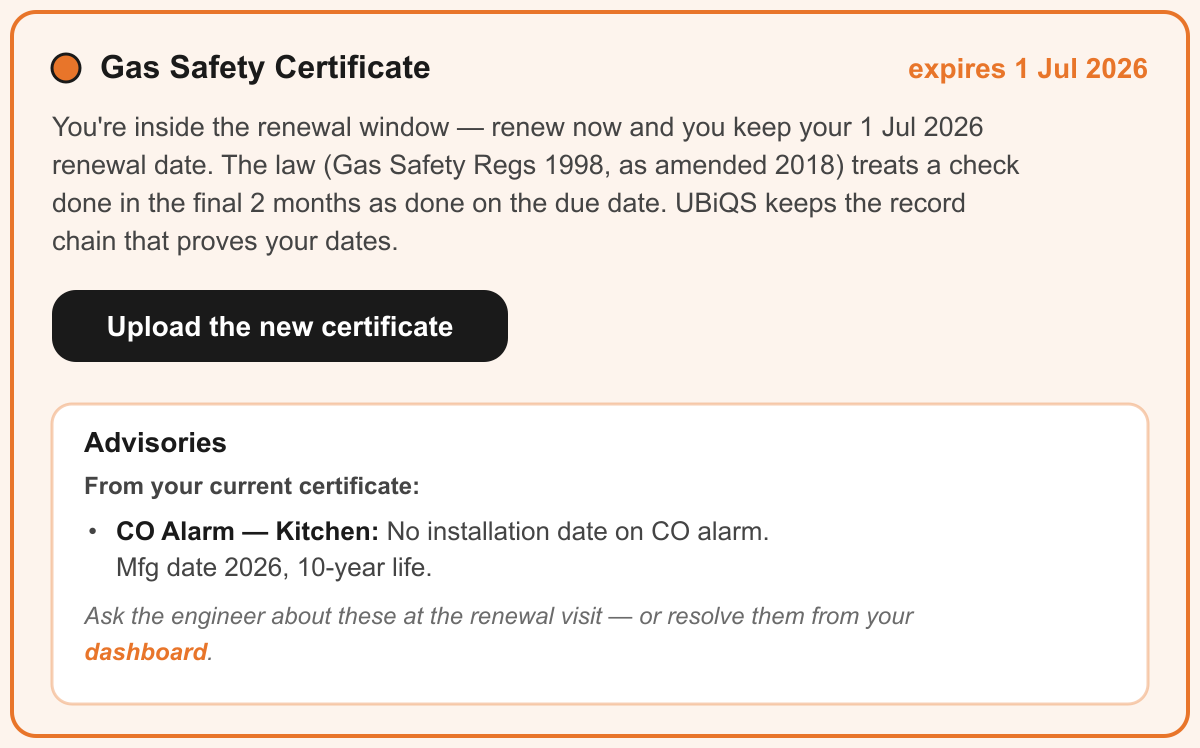 A renewal reminder with everything in one place: certificate, deadline, and the advisories to raise with the engineer at the visit.
Building Better Relationships
A landlord who books the check on time, shares the record promptly, and acts on what the engineer writes is telling their tenant something no advert can: you are safe here. That trust comes back in longer tenancies, easier access for the next visit, and a property that's looked after from both sides of the front door.
Remember: gas safety isn't paperwork with a deadline. It's one of the many duties on a landlord's list, alongside protecting your tenant's deposit, your Right to Rent checks, and Making Tax Digital. Each one matters as much as the next, and each one leaves a record. The landlords who stay ahead are the ones who keep all of it — every certificate, every deadline, every proof they acted — in one place.