What Are Tenancy Deposit Protection Schemes?
England · 6 min read · 16 July 2026 · Last reviewed 29 August 2026

You've taken a deposit from a new tenant. It's sitting in your account, and somewhere in the back of your mind is a quiet question: have you protected it correctly, and could you prove it if someone asked? If that's the worry, you're in the right place, and you're not behind. Here's how to sort it out properly.
Taking a deposit is one of the few landlord duties with a hard deadline and a real financial penalty attached. The good news is that the rule underneath it is simple, and once you understand it, it's a job you can do in an afternoon and never lose sleep over again.
The one rule underneath it all
Since April 2007, you have had a legal duty to protect a tenant's deposit in a government-approved scheme. Not "should". Must. And you have to do it quickly, within 30 days of receiving the money (gov.uk: deposit protection schemes and landlords).
Everything below is just the detail of how to do it well and keep the proof.
What to do: treat the day the deposit lands in your account as day 1 of a 30-day clock. The clock includes the day you receive it: Housing Act 2004, s.213(3) runs the 30 days "beginning with the date on which it is received". Everything else follows from that date.
The 3 schemes, and the 2 ways to hold a deposit
There are 3 government-approved tenancy deposit protection schemes in England:
Each one offers 2 options:
- Custodial: the scheme holds the deposit for you, for free. You hand the money over and they keep it until the tenancy ends. This is the simplest option, and for most landlords with 1 or 2 properties it's the easiest to keep straight.
- Insured: you (or your agent) keep the deposit in your own account, and you pay the scheme a fee to insure it. You keep the cash flow, but you carry more of the admin and the responsibility.
When you're choosing, think about what actually matters to you: whether you'd rather not touch the money at all (custodial), the fees on the insured option, and how easy the scheme's website and dispute service are to use. There's no "best" scheme. There's the one that fits how you work.
What to do: pick a scheme and an option before you advertise the property, so you're ready to protect the deposit the moment it arrives, not scrambling on day 29.
How much can you actually ask for?
The deposit isn't open-ended, and asking for too much is a mistake landlords make without realising. Under the Tenant Fees Act 2019 the deposit is capped (gov.uk: fees you can charge as part of a tenancy):
- Five weeks' rent if the annual rent is under £50,000.
- Six weeks' rent if the annual rent is £50,000 or more.
Ask for more and it becomes a prohibited payment, one the law simply doesn't allow, and an unlawfully large deposit carries its own block on getting your property back, the same trap as not protecting it. So work the cap out before you ask for the money.
Rent in advance is capped too. It's tempting to ask for rent up front instead of a bigger deposit, but from 1 May 2026 you cannot ask for any rent before the tenancy agreement is signed, and then only up to one month's rent in advance (gov.uk: fees you can charge as part of a tenancy). The advance-rent route around the deposit cap has been closed.
And the holding deposit, the small sum a tenant pays to reserve a property while your checks are done, is capped at one week's rent. Once the tenant signs the tenancy agreement you have to refund it, and the simplest way is to reduce it from the first month's rent or the deposit, so it's never money on top.
What to do: before you advertise, work out five (or six) weeks' rent for the deposit and one month for any advance, so the figures are right before a tenant ever pays you.
The 30-day clock does two things, not one
This is where good landlords trip up, so it's worth slowing down. Within that 30-day window you have to do two separate things (Housing Act 2004, s.213):
- Protect the deposit in your chosen scheme.
- Serve the "prescribed information" on your tenant.
Protecting the money is only half the duty. If you protect the deposit but forget to give the tenant the prescribed information in time, you've still broken the rule, and the penalty is the same. People assume the deadline is only about the money. It isn't.
What to do: put both tasks in the same 30-day window. Protect, then serve the paperwork, then keep evidence you did both.
What the "prescribed information" actually is
Prescribed information sounds like jargon, but it's just a defined set of facts you have to give the tenant in writing (The Housing (Tenancy Deposits) (Prescribed Information) Order 2007). You give them a copy of the deposit protection certificate, plus a document that sets out:
- The amount of the deposit and the address of the property it relates to.
- Your name and contact details as the landlord.
- The name and contact details of the tenant, and anyone who paid the deposit on their behalf.
- The name and contact details of the scheme you used.
- A copy of the scheme's information leaflet for tenants.
- How the tenant gets the deposit back at the end of the tenancy.
- What happens if there's a dispute.
What to do: most schemes generate a prescribed information template for you when you protect the deposit. Use it, serve it, and keep a dated copy showing you served it inside the 30 days.
"But hasn't Section 21 been abolished?"
Good question, and the timing catches a lot of landlords out. Section 21 was the "no-fault" eviction: the rule that let you end an assured shorthold tenancy and take your property back without having to give a reason, as long as you gave notice. Under the Renters' Rights Act 2025 it ended on 1 May 2026, and tenancies are now periodic, meaning they roll on with no fixed end date (gov.uk: Guide to the Renters' Rights Act).
For years, the deposit rules had a sharp edge attached: if you hadn't protected the deposit properly, you couldn't use a Section 21 notice to get your property back. It would be natural to assume that when Section 21 went, that edge went with it. The opposite is true.
The same Act rewrote the deposit penalty and made it wider. From 1 May 2026, a court cannot order possession at all unless, at that point, the deposit is protected in an authorised scheme and the prescribed information has been served. Before, an unprotected deposit only blocked that one Section 21 no-fault route. Now it blocks almost every legal reason you could use to get your property back, including selling it (a reason the law calls Ground 1A) or moving back in yourself (Ground 1). The only reasons it does not block are the anti-social behaviour grounds (Housing Act 2004, s.215, as substituted by the Renters' Rights Act 2025).
So it's worth asking yourself plainly: after you protected the deposit, did you also serve the prescribed information? Protecting the money is only half of it. If you did one but not the other, rectify it now. How?
How do you put it right if you haven't done both?
If you have slipped up, you can put it right, and doing it now is far better than being found short at a court hearing. Return the deposit to the tenant, in full or with any deductions you have agreed, or protect it properly and serve the prescribed information you missed. Sorting it before a possession claim restores your route to getting the property back. What you don't want is to be relying on a last-minute scramble on the day.
What to do: if you got it wrong the first time, don't just carry on as before. Put it right by working through the 3 steps UBiQS guides you through: protect the deposit (or return it), serve the prescribed information, and record the proof that you served it. Get all three in place and your route to possession is open again.
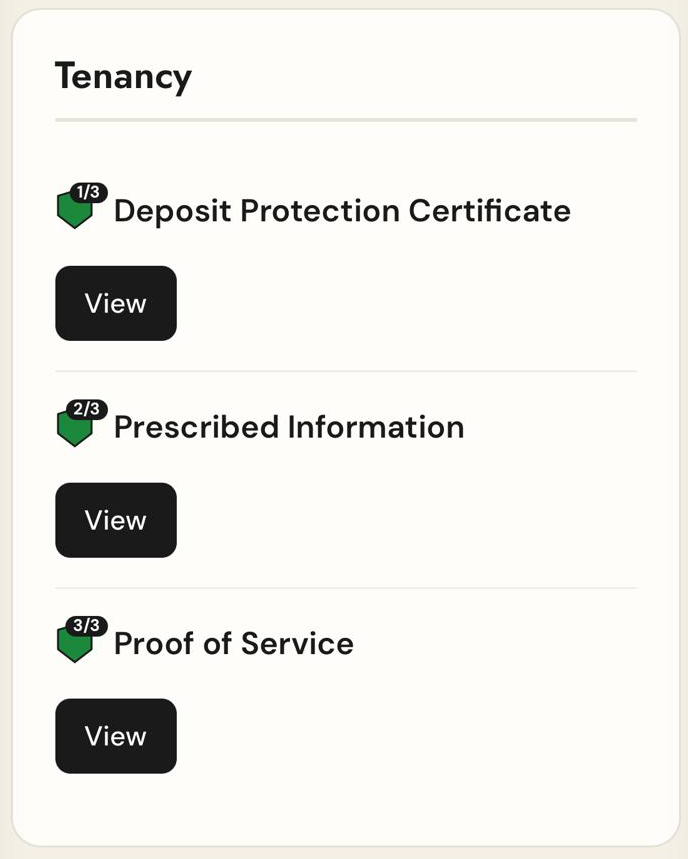
UBiQS guides you through all three: the deposit protection certificate, the prescribed information, and proof you served it, tracked together as one record.
The penalty if you get it wrong
If a tenant takes you to the county court and you didn't protect the deposit or serve the prescribed information in time, the court must order you to pay them a penalty. It's set at between 1 and 3 times the amount of the deposit, on top of returning the deposit itself, payable within 14 days of the order (Housing Act 2004, s.214).
On a £1,200 deposit, that's a penalty of £1,200 to £3,600. It's not a fine the council chases; it's money you pay directly to your tenant, and the court has little discretion to waive it. This is exactly the kind of thing that catches out the good landlord who thought they were fine, rather than the rogue who never cared.
What to do: the whole penalty turns on whether you can prove you acted in time. Keep the certificate and the served prescribed information together, both dated.
During the tenancy, and at the end
Once the deposit is protected, the best thing you can do with it is leave it alone. Keep the certificate and the tenancy paperwork in one organised place, alongside the other records every tenancy needs, like your Right to Rent checks and your annual gas safety check.
Two habits save you at the end:
- A proper inventory at move-in. A dated record of the property's condition, with photos, signed by the tenant, is your single strongest piece of evidence if you ever need to justify a deduction. Without it, disputes come down to your word against theirs.
- Routine inspections. Catching a small maintenance issue early stops it becoming the kind of damage that turns into a deposit deduction argument later.
When the tenancy ends and you've both agreed how much comes back, the deposit should be returned within 10 days of that agreement (gov.uk: deposit protection schemes and landlords). If you can't agree, every scheme offers a free dispute resolution service: you both submit your evidence, an independent adjudicator reviews it, and their decision is binding. This is why the move-in inventory matters so much. The adjudicator can only weigh the evidence you actually have.
What to do: communicate early and factually, share your evidence upfront, and be reasonable about fair wear and tear. Most disputes settle before they ever reach an adjudicator.
You understand it. Now make it provable.
Knowing the rules is half the job. The other half is being able to prove, months or years later, that you did it all in time, because that's what the penalty turns on. It's the same discipline that Making Tax Digital now asks of your rental income: the record has to exist, and you have to be able to produce it.
That's the gap UBiQS Landlord is built to close. The UBiQS deposit-protection workflow keeps the 3 documents that matter in one place: the deposit protection certificate, the prescribed information you served, and the tenant's acknowledgement that they received it. It reads the key dates and deposit amount off your certificate so you can check the 30-day window at a glance, and it stores everything together as one court-ready record. If a tenant or an adjudicator ever asks, the proof is one click away, not a hunt through a drawer.
Start your record in Tenancy, then choose Deposit Protection Certificate. It's free for your first property, no card required. Build the record as you go, and the deposit-protection workflow is waiting inside.
UBiQS, tackling the tsunami of change for personal property landlords.
Sources
All rules and figures in this guide are taken from official government sources:
- Deposit protection schemes and landlords (gov.uk)
- Housing Act 2004, section 213: the 30-day duties
- Housing Act 2004, section 214: the 1 to 3 times penalty
- The Housing (Tenancy Deposits) (Prescribed Information) Order 2007
- Guide to the Renters' Rights Act (gov.uk)
- Fees you can charge as part of a tenancy (gov.uk): the deposit, holding deposit and rent-in-advance caps